

 Technically Reviewed ~TANYA TOMAR
 Protected cultivation becomes commercially meaningful when the structure is selected around the crop, the crop around the environment, and the business around the market.
Uttar Pradesh has very different market corridors, climatic conditions, water challenges and horticultural ecosystems. The opportunity, therefore, is not simply to build a polyhouse. It is to identify where to grow, what to grow, how to grow and whom to sell to before investing.
Uttar Pradesh is not one uniform protected cultivation market. A cucumber project near Delhi-NCR operates under a very different commercial environment from a flower project serving temple and tourism demand in Mathura or Varanasi. Similarly, a nursery business in Saharanpur follows a different model from a vegetable nursery serving Prayagraj or eastern Uttar Pradesh.
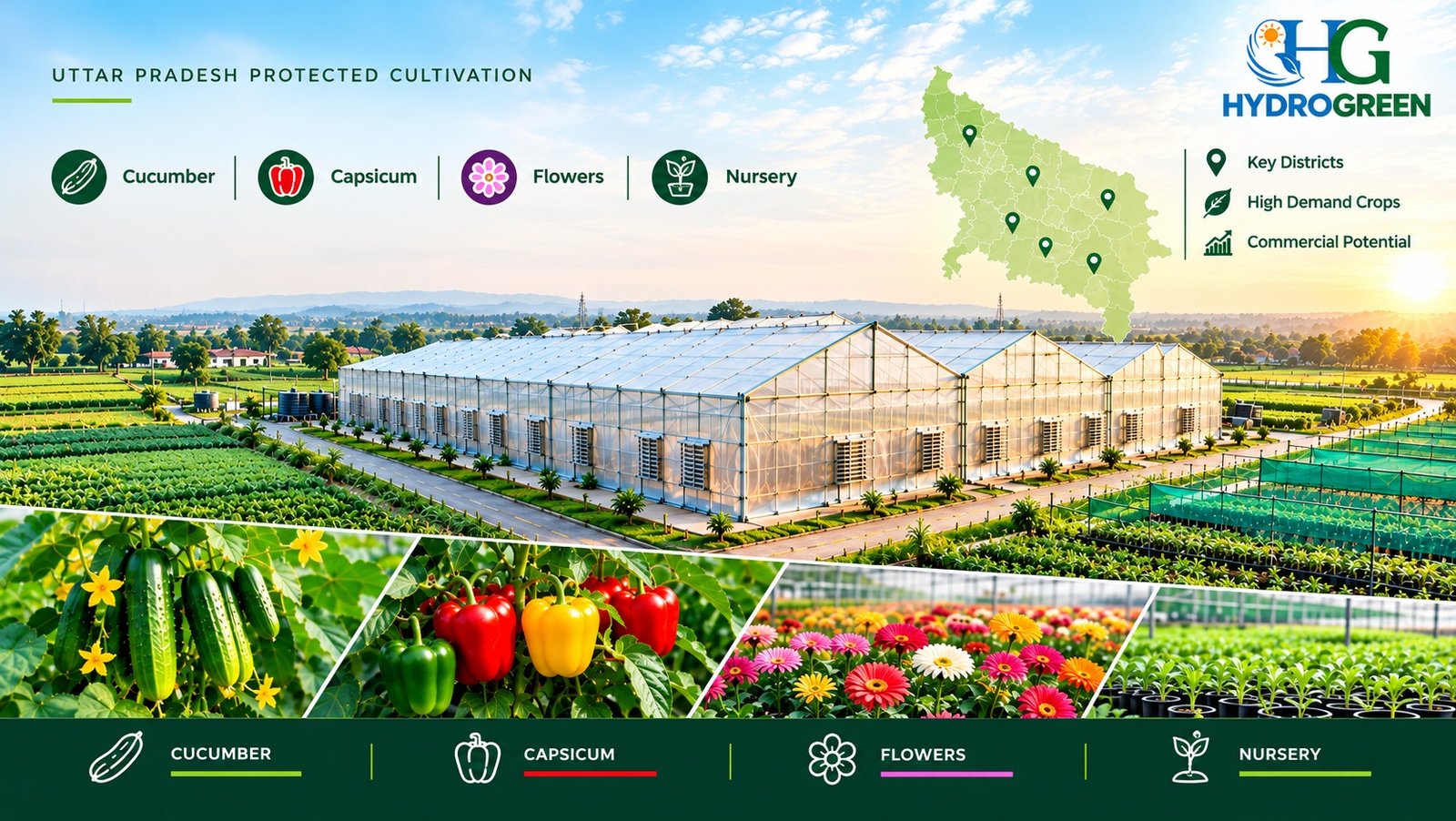
The district-level assessment identifies six particularly strong commercial locations: Gautam Buddha Nagar, Lucknow, Meerut, Ghaziabad, Saharanpur and Bulandshahr. A second opportunity layer includes Kanpur Nagar, Varanasi, Agra, Prayagraj, Gorakhpur, Mathura, Bareilly and Hapur, depending on crop and market strategy.
The core principle is simple:
The right district is where crop suitability, water, climate, market access, infrastructure and execution feasibility come together.
Before investing in protected cultivation, evaluate:
The district assessment considers market access, climate and water suitability, existing adoption/support ecosystem and demand generated by urban, hospitality, pilgrimage and tourism markets. Uttar_Pradesh_Protected_Cultivation.
| District | Key Opportunities | Market Advantage |
|---|---|---|
| Gautam Buddha Nagar | Capsicum, cucumber, flowers, exotics, nursery | Noida–Delhi NCR, retail, hotels |
| Lucknow | Capsicum, cucumber, flowers, nursery | Large urban & hospitality market |
| Meerut | Cucumber, capsicum, flowers, nursery | NCR + Meerut |
| Ghaziabad | Cucumber, capsicum, flowers, exotics | Delhi-NCR |
| Saharanpur | Nursery, flowers, vegetables | Nursery ecosystem + nearby states |
| Bulandshahr | Cucumber, capsicum, tomato | Delhi-NCR |
| Kanpur Nagar | Cucumber, capsicum, tomato, flowers | Large urban market |
| Varanasi | Cucumber, flowers, tomato, capsicum, nursery | Urban, tourism & temple demand |
| Agra | Capsicum, cucumber, tomato, flowers | Tourism, hospitality & Delhi corridor |
| Prayagraj | Cucumber, flowers, nursery | Urban + pilgrimage demand |
| Gorakhpur | Cucumber, tomato, capsicum, nursery | Regional + adjoining markets |
| Mathura | Flowers, cucumber, tomato | Temple & tourism demand |
| Bareilly | Tomato, capsicum, cucumber, nursery | Regional + Delhi/Uttarakhand |
| Hapur | Cucumber, capsicum, tomato | Delhi-NCR |
The crop and district matrix indicates that commercial potential is strongly linked to market corridors rather than agricultural production alone.
1. Gautam Buddha Nagar — NCR-Led High-Value Cultivation
Key opportunities:
Relevant systems include naturally ventilated polyhouses, net houses and selected soilless systems. The major advantage is access to Noida, Delhi-NCR, hotels, modern retail and specialised buyers. However, high land costs and groundwater pressure make project feasibility and water assessment particularly important.
2. Lucknow — A Central Market Hub
Lucknow combines urban consumption, hospitality demand and its position as the state capital.
Key opportunities include:
Short-distance supply can be valuable for fresh vegetables and flowers. Monsoon humidity and peri-urban land pressure should be considered during planning.
3. Meerut — NCR-Oriented Vegetable & Nursery Opportunity
Meerut has strong relevance for:
Its access to both Meerut and Delhi-NCR markets creates multiple selling possibilities. Cucumber scheduling and capsicum quality management become particularly important where multiple growers target the same market. Groundwater decline and fragmented landholdings should be assessed before investment.
4. Ghaziabad — Market Proximity As a Key Advantage
Ghaziabad is particularly relevant for:
Its proximity to Delhi-NCR supports fresh, regular and quality-sensitive supply models. Buyer mapping should ideally be completed before plantation.
5. Saharanpur — Nursery & Floriculture Opportunity
Saharanpur has a distinctive opportunity in:
Its nursery ecosystem and proximity to Delhi, Haryana and Uttarakhand provide a wider market catchment. For entrepreneurs seeking an alternative to harvested-vegetable businesses, nursery production can offer a model based on quality planting material, repeat buyers and pre-booked demand. Monsoon humidity and fungal disease require strong management.
6. Bulandshahr — Cucumber & Capsicum Near NCR
Bulandshahr is particularly relevant for:
Its NCR access provides a strong market advantage. However, groundwater stress and winter fog need to be incorporated into crop and structure planning.
Crop-Wise Opportunities
| Crop / Enterprise | Priority Districts |
|---|---|
| Capsicum | Gautam Buddha Nagar, Lucknow, Meerut, Ghaziabad, Bulandshahr, Agra |
| Cucumber | Gautam Buddha Nagar, Lucknow, Meerut, Ghaziabad, Bulandshahr, Kanpur Nagar, Varanasi, Prayagraj, Hapur, Bagpat, Barabanki |
| Flowers | Gautam Buddha Nagar, Lucknow, Saharanpur, Varanasi, Mathura, Ayodhya, Kannauj, Ghazipur |
| Nursery | Gautam Buddha Nagar, Lucknow, Meerut, Saharanpur, Varanasi, Prayagraj |
| Exotics / Herbs | Gautam Buddha Nagar, Ghaziabad, Jhansi, selected Lucknow/NCR markets |
The assessment identifies cucumber as having the broadest high-priority footprint, while capsicum is more concentrated around major NCR and Lucknow-oriented commercial markets.
Cucumber is widely relevant to protected cultivation because of its:
Parthenocarpic or seedless hybrids can be suitable for protected systems. However, simultaneous harvesting by many growers can create price pressure. Therefore, staggered planting, crop scheduling, grading and diversified market channels are important.
Recent ICAR-IARI research reported an average yield of 84.81 tonnes/ha for Pusa Pickling Cucumber-8 in winter low-cost polyhouse trials. This is a specific research result and should not be treated as a guaranteed commercial yield.
Priority districts include: Gautam Buddha Nagar → Lucknow → Meerut → Ghaziabad → Bulandshahr → Agra
Protected capsicum generally requires:
ICAR guidance highlights the importance of temperature and humidity management for successful capsicum fruit setting. For coloured capsicum, hotels, restaurants, organised retail and specialised food businesses can provide premium market segments.
Buyer mapping should begin before plantation—not after harvest.
Flower cultivation is driven by:
Important districts include Gautam Buddha Nagar, Lucknow, Saharanpur, Varanasi, Mathura, Ayodhya, Kannauj and Ghazipur. Uttar_Pradesh_Protected_Cultivation . Protected flower production requires attention to planting material, water quality, climate control and post-harvest handling. Grading, bunching, sleeving, cooling and rapid transportation can be critical because flowers are highly perishable.
Nursery production allows entrepreneurs to build a business around planting material rather than harvested produce. Priority districts include: Gautam Buddha Nagar, Lucknow, Meerut, Saharanpur, Varanasi and Prayagraj.
Potential products include:
Typical infrastructure can include insect-proof net houses, shade-net structures, pro-trays, cocopeat, misting/fogging and hardening areas.
Saharanpur is particularly relevant for nursery activity, while specialised opportunities also exist in other regional horticultural clusters.
Regional Strategy: Think In Clusters
| Region | Priority Strategy |
|---|---|
| Western UP / NCR | Cucumber, capsicum, exotics, flowers, nursery |
| Awadh | Cucumber, capsicum, flowers, nursery |
| Braj | Braj Flowers + vegetables |
| Central Doab | Cucumber, vegetables, flowers/nursery |
| Prayagraj Belt | Nursery, cucumber, flowers |
| Purvanchal | Vegetables, flowers, nursery |
| Bundelkhand | Water-efficient systems, nursery, vegetables |
Western UP is strongly NCR-facing, while Lucknow anchors Awadh. Braj has flower and tourism-linked opportunities, and Bundelkhand requires greater emphasis on water-efficient cultivation systems.
Select The Structure After the Project Strategy
The recommended decision sequence is: MARKET → CROP → CLIMATE → WATER → STRUCTURE → TECHNOLOGY → ECONOMICS → EXECUTION
| Objective | Potential Structure |
|---|---|
| Cucumber | NVPH / insect-proof net house |
| Coloured capsicum | Naturally ventilated polyhouse |
| Cut flowers | NVPH with suitable environmental management |
| Nursery | Insect-proof net house / shade-net |
| Water-stressed areas | Shade-net + drip + mulching |
| Flood-prone areas | Raised beds + drainage + suitable structure |
A structure should be engineered around the crop and local conditions—not selected as a standalone product.
Water Quality is a Project Gatekeeper
Before finalising a protected cultivation project, test:
Water quality directly influences fertigation, root-zone management and crop performance. Therefore: Test the water before finalising the crop, fertigation system and project economics.
Before You Invest: District-Level Checklist
Evaluate:
Government Support & Subsidy
Protected cultivation and horticulture projects may receive support through applicable government programmes such as MIDH and related state horticulture initiatives, subject to current eligibility, components, cost norms and implementation procedures. Current NHB/MIDH guidelines include provisions and cost norms for protected cultivation. Applicants should always verify the latest official notification rather than relying on older subsidy percentages. Subsidy should be treated as project support—not as the foundation of profitability.
Financial Thinking: Revenue is Not Profit
A project should not be evaluated only through expected yield × selling price.
• Gross Revenue = Marketable Production × Realised Selling Price
• Net Profit = Gross Revenue − Production Costs − Labour − Inputs − Energy − Maintenance − Packaging − Transport − Finance Costs − Other Expenses
Market price fluctuations can materially change project outcomes. Documented ICAR success cases demonstrate the potential of protected cultivation, but individual case studies should never be treated as guaranteed returns for a new project.
A successful protected cultivation project requires alignment between:
ENGINEERING + AGRICULTURE + AGRONOMY + TECHNOLOGY + ECONOMICS + EXECUTION
HYDROGREEN can support project planning through:
For Gautam Buddha Nagar, the priority may be NCR premium buyers. For Saharanpur, nursery or floriculture may provide a different commercial pathway. For Varanasi, flowers and vegetables may be aligned with urban, tourism and temple markets. In Bundelkhand, water efficiency may become the first design consideration. That is why Hydrogreen's role is not simply to supply a structure. The objective is to connect district + crop + water + climate + market into an execution-ready project.
Key opportunities include Gautam Buddha Nagar, Lucknow, Meerut, Ghaziabad, Saharanpur and Bulandshahr, followed by Kanpur Nagar, Varanasi, Agra, Prayagraj, Gorakhpur, Mathura, Bareilly and Hapur. Final suitability depends on crop, water, structure and market.
Important districts include Gautam Buddha Nagar, Lucknow, Meerut, Ghaziabad, Bulandshahr, Kanpur Nagar, Varanasi, Prayagraj, Hapur, Baghpat and Barabanki.
The leading locations identified are Gautam Buddha Nagar, Lucknow, Meerut, Ghaziabad, Bulandshahr and Agra
Flower opportunities include Gautam Buddha Nagar, Lucknow, Saharanpur, Varanasi, Mathura, Ayodhya, Kannauj and Ghazipur. Nursery opportunities are particularly relevant in Gautam Buddha Nagar, Lucknow, Meerut, Saharanpur, Varanasi and Prayagraj.
Support may be available through applicable horticulture programmes such as MIDH and state-level schemes. Eligibility, admissible components and assistance depend on current guidelines and project category. Applicants should verify the latest requirements with the relevant authorities.
Conclusion: Uttar Pradesh Needs A Market-Led Protected Cultivation Strategy
Uttar Pradesh offers multiple protected cultivation opportunities, but the opportunity is not identical across all districts.
The major commercial corridors include:
NCR: Gautam Buddha Nagar, Ghaziabad, Meerut, Bulandshahr
Lucknow: Cucumber, capsicum, flowers and nursery
Saharanpur: Nursery and floriculture
Varanasi: Cucumber, flowers, vegetables and nursery
Agra–Mathura: Vegetables and tourism/temple-linked flowers
Prayagraj: Nursery, cucumber and flowers
Gorakhpur: Vegetables and nursery
The key question is not simply: “Which crop is profitable?” It is: “Which crop fits my district, water, climate, structure, investment capacity and market?” That shift—from crop-first thinking to project-first thinking—can make protected cultivation more scientifically planned and commercially resilient. For Uttar Pradesh, the future of protected cultivation will increasingly depend on better district selection, precise crop planning, resource efficiency, stronger market linkages and professional project execution.
Sources / Data Sources
1. National Horticulture Board — MIDH Operational Guidelines 2025: Protected cultivation cost norms and project framework. National Horticulture Board — MIDH Guidelines
2. National Horticulture Board — Current Scheme & Application Information: Current guideline notifications and application requirements. NHB Scheme & Application Information
3. Mission for Integrated Development of Horticulture (MIDH): Horticulture development framework. MIDH — Government of India
4. ICAR — Indian Council of Agricultural Research: Protected cultivation and horticultural research. ICAR Horticultural Science
5. ICAR-IARI: Recent research on cucumber production under protected cultivation. ICAR Indian Horticulture — May–June 2026
6. ICAR-IIVR, Varanasi: Protected cultivation and technical support for vegetable production. ICAR-IIVR Protected Cultivation
7. Government of Uttar Pradesh — Department of Agriculture: State agricultural resources. UP Agriculture — Agridarshan
8. District-level crop, market, structure and regional assessment: Used for the district and crop prioritisation presented in this article.
TANYA TOMAR (Protected Cultivation Expert )