

 Technically Reviewed ~TANYA TOMAR
 This makes one point particularly important for farmers:
Do not select a protected structure only because of a subsidy percentage. Select it according to the crop, climate, required level of protection, capital available and expected economics.
A net house is a protected cultivation structure in which crops are enclosed or partially enclosed with agricultural nets instead of a complete plastic-film covering.
Depending on the design and net selected, the structure can provide protection against:
Unlike a fully covered polyhouse, a conventional net house generally allows greater natural air movement.
This makes it particularly relevant in crops and locations where the farmer needs physical protection and microclimate moderation, but does not necessarily require the same degree of environmental control as a greenhouse.
The 2025 MIDH operational guidelines specifically recognise shade net houses among the protected-cultivation structures promoted under the Mission. The guidelines also state that irrigation costs are included within the relevant protected-structure cost provisions and that materials/technologies used for subsidy assistance should conform to applicable BIS standards.
The main reason is not simply subsidy.
The bigger consideration is the relationship between:
Initial investment → protected area → crop suitability → operating cost → production → market price → repayment capacity
A farmer with limited capital may not need the same infrastructure intensity as a high-value crop producer requiring stronger environmental control.
A net house can therefore become an important middle option between:
Open-field cultivation → Net-house cultivation → Polyhouse / greenhouse cultivation
The correct choice depends on the production objective.
ICAR has documented protected-cultivation projects where farmers used both shade-net houses and polyhouses for vegetables and flowers, including tomato, capsicum, cucumber, broccoli, gerbera and roses.
A flat-roof net house uses a relatively simple horizontal or gently structured roof arrangement supported by columns and structural members.
It is one of the commonly considered designs for protected horticulture where shade and physical crop protection are the primary objectives.
Typical applications include:
The exact shade percentage and net specification should be selected according to the crop and local climatic conditions.
Its relatively straightforward geometry can make construction, maintenance and expansion easier to plan.
Best suited for: Farmers looking for a functional protected structure with comparatively straightforward construction.
A dome-shaped net house uses a curved or arched roof profile rather than a flat roof.
The curved geometry can provide better structural continuity and useful internal volume depending on the engineering design.
It can be considered where the farmer wants:
The actual performance depends on structural design, material specification, net quality, anchoring and local wind conditions.
Best suited for: Commercial growers seeking a stronger engineered net-house configuration for larger or more professionally planned projects.
A tunnel net house uses repeated arches to create a tunnel-like protected structure.
The design can be suitable for selected vegetable crops, nurseries and seasonal protected cultivation.
Its geometry can provide useful crop-row organisation and facilitate crop management.
Tunnel structures may also be considered where the farmer wants a relatively modular protected cultivation arrangement.
Best suited for: Selected vegetables, nursery applications and farms where a tunnel configuration matches crop and operational requirements.
A wire-rope net house uses engineered wire-rope arrangements together with supporting columns and netting.
This design can be particularly useful for larger-area projects where structural layout, tensioning and load distribution are carefully engineered.
A properly designed wire-rope system can support large protected areas while maintaining an organised structural framework.
The actual design should be based on:
Best suited for: Larger commercial farms and projects requiring a professionally engineered net-house system.
Depending on the project, net houses can also incorporate:
Hydrogreen Energy can help farmers evaluate which configuration is appropriate instead of treating every net house as the same product.
| Factor | Net House | Polyhouse |
|---|---|---|
| Main covering | Agricultural net | Poly film/plastic covering |
| Light environment | Depends on net specification | More controlled through covering |
| Natural airflow | Generally higher | Depends on design and ventilation |
| Environmental control | Moderate | Can range from moderate to highly controlled |
| Initial infrastructure requirement | Often lower for comparable applications | Generally higher for more controlled systems |
| Crop protection | Shade, insects, birds and selected weather stresses | Broader environmental and weather protection |
| Crop suitability | Crop- and climate-specific | Wider range, including crops needing greater environmental control |
| Cooling requirement | Often lower in naturally ventilated applications | May require additional ventilation/cooling depending on design |
| Investment approach | Suitable for lower-entry protected cultivation models | Suitable where higher control can justify higher investment |
| Best decision factor | Crop + climate + protection requirement | Crop + climate + control requirement + economics |
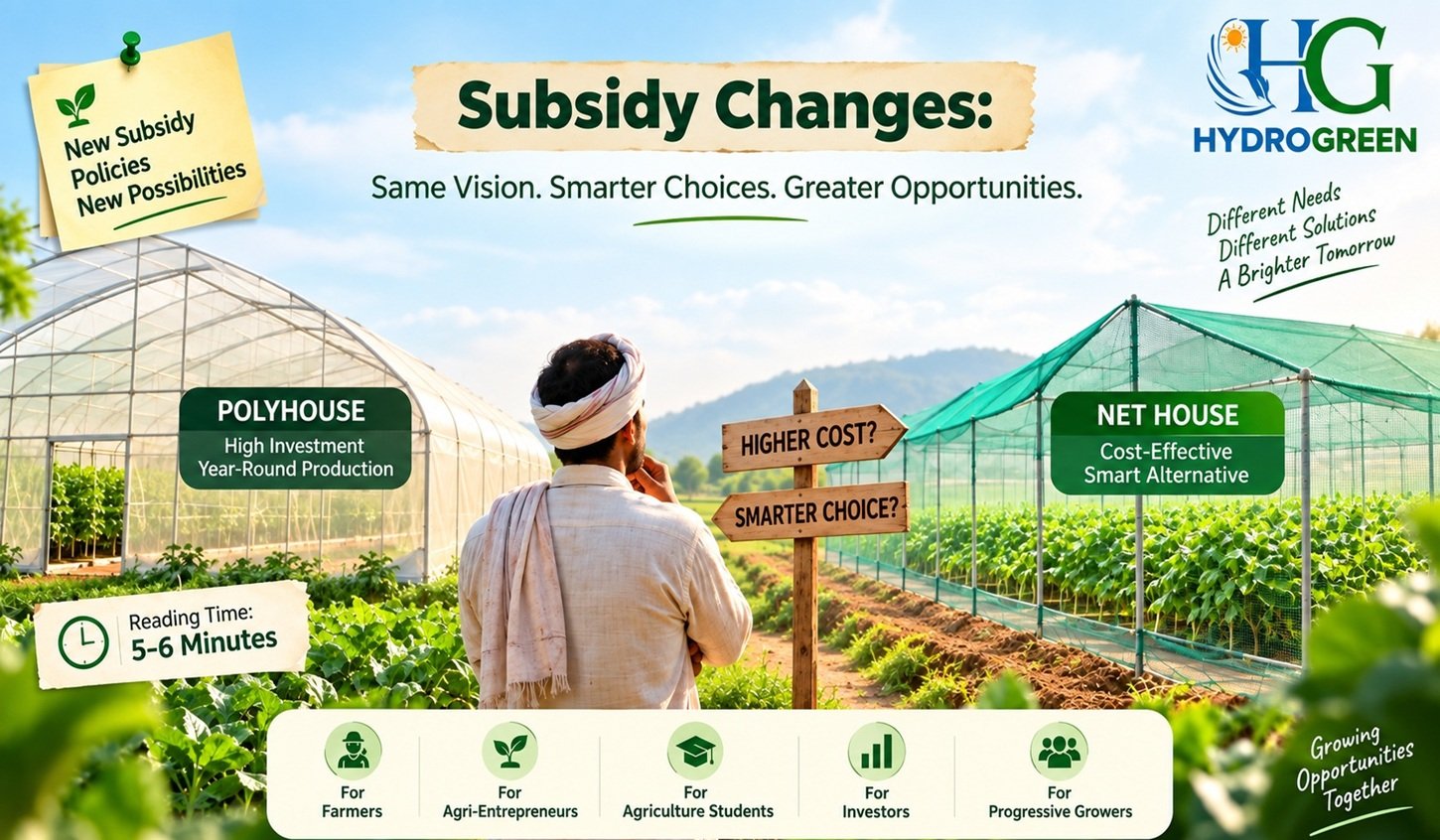
This comparison should not be interpreted as saying that one structure is universally superior.
A polyhouse provides a different level of environmental management.
A net house becomes financially interesting when the crop does not require the additional control provided by a more intensive greenhouse system.
Crop selection should always come before structure selection.
Depending on climate, net specification, crop variety and management system, net-house cultivation can be considered for crops such as:
ICAR documentation on protected cultivation demonstrates the use of shade-net houses and polyhouses for crops including tomato, capsicum, cucumber, broccoli, gerbera and roses.
Recent ICAR literature also identifies protected structures such as insect-proof net houses, shade houses, polytunnels and polyhouses as options for high-value vegetable production, with crop selection including capsicum, tomato, parthenocarpic cucumber and cherry tomato depending on the production environment.
Yes, but production cannot be judged by structure alone.
Production depends on:
A technically good structure with poor crop management can still produce poor results.
Conversely, a correctly selected net house combined with good agronomy can support commercially useful production.
ICAR field experience also demonstrates an important lesson: technical guidance and crop-management knowledge are critical to protected cultivation performance.
For applications where complete greenhouse control is unnecessary, a net house can require a lower level of structural and environmental-control infrastructure.
This can reduce the initial capital requirement compared with a more sophisticated polyhouse project.
Net structures can allow substantial natural air movement.
This can be valuable in climates where excessive heat accumulation is a concern.
Properly selected nets can help reduce exposure to insects, birds, excessive radiation and certain environmental stresses.
When combined with drip irrigation and fertigation, protected cultivation can support more controlled application of water and nutrients.
Farmers can design the project around their actual investment capacity and crop plan rather than automatically selecting the most expensive protected structure.
Net houses can be highly useful for nursery and seedling production where protection from insects, radiation and weather stress is important.
There is no single universal net-house cost per acre.
Project expenditure varies with:
A farmer should therefore avoid comparing quotations only on the headline "₹ per square metre."
A cheaper quotation may exclude irrigation, fertigation, foundations, crop-support systems or other necessary components.
The correct comparison is:
Total project cost + technical specification + expected crop use + maintenance requirement
The financial advantage of a net house generally comes from capital efficiency, not from a guaranteed higher profit.
If two farmers cultivate crops that can perform adequately under different structures, the farmer who does not need unnecessary environmental-control infrastructure may avoid investing capital in systems that the crop does not require.
A simplified investment logic is:
Lower initial infrastructure requirement → Lower capital exposure → Potentially lower financing burden → More manageable project scale → Potentially faster path to operational stability
However, this does not mean every net house will automatically be more profitable than every polyhouse.
A high-value crop requiring temperature, humidity or disease-control conditions that a net house cannot provide may justify the higher investment in a polyhouse.
Therefore:
The financially better structure is the one that provides sufficient crop protection without paying for control that the crop and business model do not actually need.
This is where farmers need to be particularly careful in 2026.
The NHB's published protected-cultivation guideline identifies greenhouses, shade net houses, plastic mulch, plastic tunnels and anti-bird/hail nets among eligible protected-cultivation activities under its commercial horticulture framework.
The same published NHB guideline states a credit-linked back-ended subsidy of 50% of total project cost, up to ₹56 lakh per project, subject to admissible cost norms and applicable conditions.
However, farmers should not treat this historical/published figure as an automatic entitlement for a new 2026 application.
NHB's current website states that its January 2025 operational guideline is under revision with reference to the 21 August 2026 amendment, and it also lists a temporary suspension of fresh GoC applications under Scheme No. 1 and Scheme No. 2 from September 2026.
Separately, the Ministry's August 2025 modification increased the protected-cultivation area threshold under NHM/HMNEH and NHB from 2,500 sq m to 4,000 sq m and above per beneficiary, effective from 12 August 2025.
Therefore, the correct approach is:
Scheme implementation can also vary through the relevant state horticulture machinery and applicable MIDH/NHM arrangements.
A farmer may receive financial assistance and still struggle if:
Protected cultivation is ultimately a production business, not simply an infrastructure purchase.
The farmer should calculate:
Revenue − cultivation cost − labour − inputs − irrigation/fertigation − maintenance − finance cost − marketing/post-harvest cost = operating economics
This is why a lower-cost structure can sometimes make more financial sense than a more expensive structure, even when the latter appears technologically superior.
Hydrogreen's role should not stop at supplying a structure.
The starting point should be the farmer's:
Crop + Climate + Land + Investment + Water + Market
Hydrogreen can guide the farmer through the net-house planning process, including:
The objective is to avoid the common mistake of buying a structure first and asking crop and economics questions later.
Hydrogreen approaches protected cultivation through:
Engineering + Agriculture + Agronomy + Execution
This becomes especially important when farmers are comparing a net house with a polyhouse.
The right question is not: "Which structure looks better?"
It is:
"Which structure is technically sufficient for my crop and financially sensible for my project?"
Farmers planning a net-house project can discuss their land area, crop, location, water availability and investment plan with Hydrogreen to evaluate an appropriate structure and installation approach.
| If your priority is… | Structure to investigate |
|---|---|
| Basic crop protection and shade | Net House |
| Insect exclusion | Insect-Net House |
| Nursery/seedling protection | Net House / Insect-Net House |
| Large-area commercial protected cultivation | Net House or Polyhouse depending on crop |
| Stronger environmental control | Polyhouse |
| Temperature/humidity management | Polyhouse |
| High-value crops requiring controlled conditions | Polyhouse may be more appropriate |
| Lower-entry protected cultivation for suitable crops | Net House may be more suitable |
| Maximum climate control | Higher-specification greenhouse/polyhouse |
| Financially conservative project | Evaluate Net House first if crop requirements permit |
This is a decision framework, not a universal rule.
The crop and location must determine the final structure.
Protected cultivation is moving beyond the simple question of "polyhouse versus open field."
Farmers now have a wider range of structures and technologies.
The important shift is toward matching infrastructure intensity with production requirements.
A farmer does not necessarily need the most sophisticated structure.
The farmer needs the right structure.
If a net house can provide the required crop protection, maintain an appropriate growing environment and fit within the farmer's investment capacity, it can be a strong protected-cultivation option.
If the crop requires greater environmental control, a polyhouse may still be justified.
The financial decision should therefore be based on total project economics, not subsidy alone.
The question "Is net house better than a polyhouse?" does not have one answer for every farmer.
But for farmers whose crops can perform effectively under net-house conditions, a net house can offer an important financial advantage by potentially reducing the initial infrastructure requirement while still providing meaningful crop protection.
The latest subsidy environment makes careful project planning even more important because scheme conditions, application windows, cost norms and eligibility must be checked against the current official framework. NHB currently lists both recent guideline amendments and a temporary suspension affecting fresh GoC applications, so farmers should verify the live status before making investment commitments.
The smarter approach is therefore:
" Do not choose the structure because of subsidy. Choose the structure because it fits the crop, climate, investment and market ".
For many suitable crops, that evaluation may lead the farmer toward a net house rather than a higher-investment polyhouse.
For other crops, a polyhouse may remain the technically appropriate option.
The objective is not simply to construct a protected structure.
The objective is to build a technically planned and financially workable cultivation project.
Hydrogreen helps farmers evaluate and plan net-house projects from structure selection and installation to irrigation, fertigation and project execution—so the investment begins with the farming objective rather than the structure alone.
In many applications, a net house can have a lower initial infrastructure requirement because it does not use the same level of enclosed covering and environmental-control systems as a polyhouse. However, actual cost depends on structure design, area, material, net specification, irrigation and other project components.
Crop suitability depends on climate, net specification and production objective. Vegetables such as tomato, capsicum and cucumber, along with nurseries, leafy vegetables, flowers and selected high-value horticultural crops, can be considered under appropriate conditions.
Protected cultivation schemes can include shade net houses, but eligibility, cost norms, area requirements, application status and assistance pattern depend on the applicable current government scheme. NHB's published framework includes shade net houses, but farmers should verify the latest applicable rules before investing.
Not automatically. A net house can have a financial advantage where the crop does not require the higher level of environmental control associated with a polyhouse. Profitability still depends on crop yield, market price, input costs, labour, finance, maintenance and farm management.
Yes. Hydrogreen can guide farmers in evaluating the suitable net-house configuration, including flat-roof, dome-shaped, tunnel and wire-rope designs, along with structure planning, irrigation/fertigation integration, project estimation and installation-oriented execution. The appropriate solution is selected according to the crop, climate, land, investment and project requirements.
National Horticulture Board (NHB): Revised scheme information, protected-cultivation provisions, cost norms, assistance framework, eligibility and application requirements.
Ministry of Agriculture & Farmers Welfare / MIDH: MIDH Operational Guidelines 2025 covering protected cultivation, shade-net houses, irrigation provisions, construction materials and technical requirements.
Government of India, MIDH Horticulture Division: August 12, 2025 modification increasing the protected-cultivation area threshold to 4,000 sq m and above per beneficiary under the specified MIDH/NHB framework.
NHB Current Announcements, 2026: Current notices including the August 21, 2026 amendment and September 2026 temporary suspension of fresh GoC applications under NHB Schemes No. 1 and 2.
ICAR – Central Institute of Agricultural Engineering: Field documentation on protected cultivation using shade-net houses and polyhouses for horticultural crops and the importance of technical support.
ICAR – Indian Institute of Vegetable Research: Field documentation demonstrating the importance of technical crop-management guidance in protected cultivation.
ICAR Research Literature: Recent technical literature on protected cultivation of high-value vegetable crops and the use of net houses, shade houses, tunnels and polyhouses.
TANYA TOMAR (Protected Cultivation Expert )