

 Technically Reviewed ~TANYA TOMAR
 A concise guide to the NHB New Guidelines 2026–27, covering revised eligibility rules, the expanded family definition, new financial assistance rates and their impact on horticulture and cold storage project planning.
The National Horticulture Board's revised framework for Commercial Horticulture and Cold Storage projects has changed the way applicants need to approach financial assistance and project planning. The amendment issued through Public Circular No. NHB/CC/Guidelines/2026-27/2101 dated 21 August 2026 introduces important changes relating to family definition, applicant eligibility and financial assistance. The most important message for investors is simple: an NHB-supported project can no longer be planned using assumptions based on older guidelines. The latest official NHB scheme page lists the amendment and notes that the January 2025 operational guidelines are under revision with reference to the 21 August 2026 amendment.
NHB Revised Guidelines for the Schemes
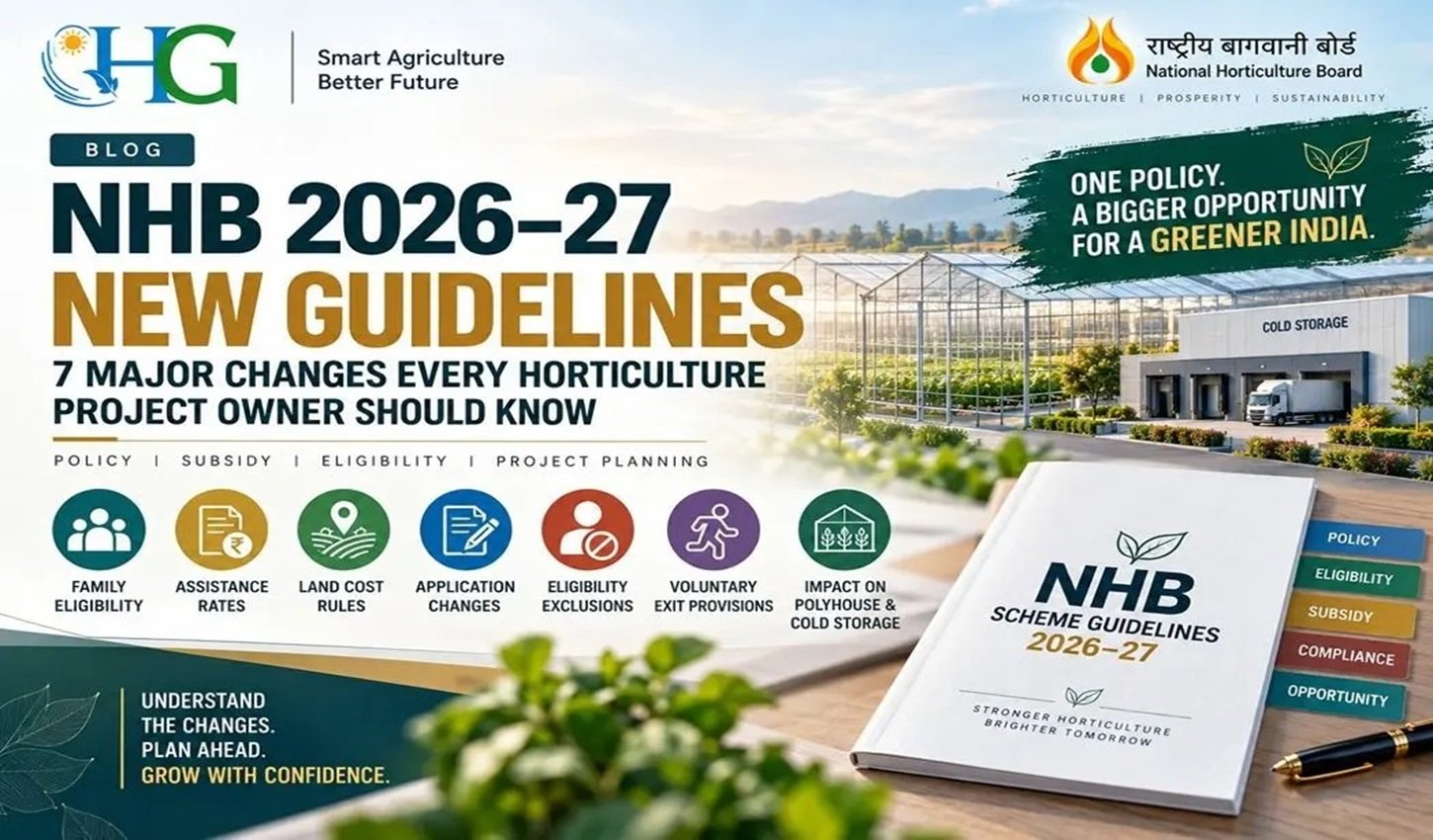
The 21 August 2026 amendment brings several significant changes. At a practical level, project owners should pay particular attention to these seven areas:
1. The definition of family has been clarified and expanded.
2. Only one eligible member of a family can avail NHB financial assistance.
3. Several categories of public officials, government employees and specified beneficiaries are excluded from assistance.
4. Financial assistance rates and project-cost treatment have changed for applicable activities.
5. Land cost is treated separately from eligible project cost in the relevant provisions.
6. Application charges and application-related requirements have changed.
7. Voluntary exit and repayment provisions can have major financial consequences.
These changes make project planning more important than simply calculating a percentage subsidy
One of the biggest changes concerns the definition of “family.” Previously, “family” meant only a spouse and dependent minor children. The revised definition now includes the spouse, father, mother, sons and daughters, regardless of dependency status. This means eligibility assessment may extend beyond the individual applicant.
Before planning a project, applicants should review whether another relevant family member has already availed NHB financial assistance under the applicable provisions. Separate business entities or independent adult status should not automatically be assumed to create separate eligibility.
Another major change is the introduction of a stronger family-level restriction on financial assistance. Under the revised framework, the general principle is that only one member of a family may avail NHB financial assistance, subject to the applicable scheme provisions and eligibility conditions. This can affect applications made through different business structures.
For example, agricultural projects may be developed through:
Individual Ownership → Proprietorship → Partnership → HUF → Company
However, creating a separate legal entity should not automatically be interpreted as creating independent eligibility for NHB financial assistance. The relationship between the applicant, the business structure and the family-level eligibility provisions must all be examined.
If one eligible family member has already availed NHB financial assistance, another family member may not necessarily be able to create a separate entity and independently access the same financial assistance framework. The project must be assessed according to the latest applicable guidelines rather than assumptions based solely on the legal structure of the business. This makes accurate declarations and documentation increasingly important.
Project planners should assess family relationships and previous assistance history before selecting an applicant or structuring a new agricultural enterprise.
The revised provisions identify several categories that may be restricted from directly receiving financial assistance. These include constitutional post holders; sitting ministers, MPs and MLAs; certain government employees; employees of PSUs and autonomous bodies; and pensioners receiving ₹10,000 or more per month. Certain exceptions apply to categories such as MTS, Class-IV and Group-D employees, according to the applicable provisions.
The revised rates can significantly affect project financing. In general-category states, financial assistance has been reduced from 50% to 35% of eligible project cost. In North Eastern and Himalayan states, assistance has been revised from 50% to 45% of eligible project cost. However:
Total Project Cost ≠ Eligible Project Cost ,Eligible Project Cost ≠ Automatic Financial Assistance
The final amount depends on approved components, applicable cost norms, eligibility and compliance with the current scheme framework.
NHB Official Schemes Information
Another major point highlighted in the policy communication is the treatment of land cost. For the relevant project-cost calculation, land is excluded from eligible project cost. This has a direct impact on project feasibility.
Consider a hypothetical project:
The applicant cannot automatically assume that the entire ₹1.80 crore becomes the subsidy base.
If the ₹40 lakh land purchase is excluded, the relevant project-cost calculation may begin with the eligible ₹1.40 crore, subject to the applicable NHB norms. This changes the way entrepreneurs should structure their financial model.
The correct approach is:
Land requirement → separate investment
Eligible infrastructure → scheme-based project cost
Admissible cost → subsidy calculation
This distinction becomes especially important in locations where agricultural land prices are high. For a new protected-cultivation project, investors should therefore avoid presenting land acquisition as though it were equivalent to greenhouse construction, irrigation infrastructure or eligible equipment
The revised system also places greater importance on the application process. The supplied policy infographic highlights revised application charges . Applicants should not, however, confuse the application fee with the subsidy or project approval itself. NHB's online application information separately specifies application-cost slabs. Its currently published online fee structure shows ₹1,000 for projects up to ₹10 lakh, ₹2,000 for projects above ₹10 lakh up to ₹20 lakh, ₹5,000 for projects above ₹20 lakh up to ₹50 lakh, and ₹10,000 above ₹50 lakh under the displayed fee structure.
Because the 21 August 2026 amendment is now listed by NHB as the latest amendment, applicants should use the fee and application requirements applicable to their current application rather than relying on an old brochure. (National Horticulture Board)
Documentation can include project-related financial, technical, ownership, eligibility and institutional records. NHB's current scheme page separately lists:
The lesson is simple:
Do not start construction planning first and think about documentation later. The documentation strategy should begin with the DPR itself.
The policy communication also highlights a voluntary exit option. This is an important point for project owners because receiving government assistance creates obligations. Under the illustrated provision, voluntary exit can involve repayment of:
Therefore, subsidy should never be treated as unconditional income.
If an applicant accepts financial assistance and subsequently decides to exit the scheme, the financial implications need to be understood before taking that decision. This is consistent with the broader structure of government-supported projects, where beneficiaries are expected to comply with conditions attached to financial assistance. NHB's scheme framework includes project completion, inspection, documentation and subsidy-claim procedures, reinforcing the fact that assistance is linked to compliance rather than being a simple upfront grant. (National Horticulture Board)
Project eligibility and application availability are two different things. NHB's current public notifications and scheme framework should always be checked before an investor commits to a project timeline or financial model. The NHB website provides access to its scheme guidelines, application resources and current LoC/GoC information.
NHB Official Website NHB LoC/GoC Circulars
A stronger project-planning sequence is:
Project Feasibility → Family Eligibility → Applicant Category → Financial Capacity → Current Scheme Status → Application Planning
Financial assistance should support a viable project—not create the illusion of viability.
Policy changes make professional project planning more important than ever. A protected cultivation, commercial horticulture or cold-storage project involves much more than selecting infrastructure and estimating financial assistance.
At Hydrogreen, the planning approach can begin with the actual project fundamentals:
Crop → Climate → Water → Technology → Structure → Investment → Market → Execution
Depending on the project requirement, Hydrogreen can support planning and implementation across protected cultivation systems, polyhouses structures, net houses structures, commercial horticulture infrastructure, cold-storage solutions and other agricultural projects.
The objective is not simply to install infrastructure. It is to connect:
Engineering + Agriculture + Agronomy + Execution
Where government support is relevant, project planning should also consider the latest scheme framework, eligibility requirements, technical norms and application status.
Planning a horticulture, protected cultivation or agri-infrastructure project? Start with the project's technical and commercial feasibility—not just the expected financial assistance. Hydrogreen can help bring structure, agriculture, technology and execution into one informed project-planning process.
1. What changed in the NHB guidelines for 2026–27?
The revised framework introduced changes to family definition, family-level financial assistance, applicant eligibility and assistance rates.
2. What is the new definition of family?
It now includes the spouse, father, mother, sons and daughters, regardless of dependency status.
3. What is the new NHB financial assistance rate?
The rate is 35% of eligible project cost in general-category states and 45% in North Eastern and Himalayan states, subject to applicable scheme conditions.
4. Can more than one family member receive NHB financial assistance?
The revised framework applies a family-level restriction under which only one member may avail assistance, subject to the applicable provisions.
5. Should a project be planned only around the expected subsidy?
No. Technical feasibility, market potential, operating costs and financial capacity should be evaluated before potential government assistance is considered.
The NHB new guidelines for 2026–27 represent a significant shift in the way agricultural investors must approach eligibility and project planning. The revised family definition now creates a broader family-level framework. The one-family financial assistance principle requires greater attention to previous assistance history. New restrictions on specific categories of applicants make eligibility verification more important. At the same time, the reduction in financial assistance rates means project economics may need to be reassessed. The current position regarding fresh GoC applications adds another layer to project planning.
The most important lesson is simple:
Do not begin with the question, “How much assistance can I get?” Begin with: Is the project technically suitable? → Is it commercially viable? → Is the applicant eligible? → Is the scheme currently accepting applications? → What level of financial assistance may actually apply?
Modern agricultural investment requires better planning, not just more infrastructure. For farmers, investors and agripreneurs, the new NHB equation is ultimately about moving from assumption-based decisions to informed project planning.
The strongest projects will be designed around agriculture, engineering, economics and execution—with financial assistance considered as one part of the overall equation, not the entire equation.
1. National Horticulture Board — Revised Guidelines
View the official NHB revised guidelines and 2026 amendment listing
2. National Horticulture Board — Official Schemes
View official NHB scheme information
3. National Horticulture Board — Official Website
Visit the National Horticulture Board website
4. NHB LoC and GoC Circulars
View NHB LoC and GoC circulars
Disclaimer: NHB guidelines, application procedures, financial assistance rates and eligibility conditions may be amended. Applicants should verify the latest official circulars and scheme documents before making an investment or submitting an application.
Modern agricultural investment is becoming more sophisticated, and policy changes are part of that evolution.
The strongest project decisions will increasingly come from people who understand that a successful agricultural venture cannot depend on one incentive, one technology or one assumption. It must be built on technical planning, accurate information, responsible investment and long-term agricultural performance.
~TANYA TOMAR
(Protected Cultivation Expert)
My vision is to make complex protected cultivation and agricultural infrastructure decisions easier to understand—so farmers and investors can move from interest to informed action.