

 Technically Reviewed ~TANYA TOMAR
 Discover how a polyhouse creates a controlled growing environment by managing temperature, humidity, light, ventilation, water and crop conditions for better cultivation.
Discover how a polyhouse creates a controlled growing environment by managing temperature, humidity, light, ventilation, water and crop conditions for better cultivation.
A crop does not grow according to the calendar alone. It responds continuously to its surrounding environment—temperature, humidity, sunlight, air movement, water availability, soil conditions and nutrient supply. In open-field farming, most of these factors are directly influenced by the weather. A sudden heatwave can increase plant stress. Excess rainfall can disturb the root zone. High humidity can encourage disease development, while strong radiation can increase water demand. A polyhouse changes this relationship by creating a partially controlled growing environment around the crop.
Instead of allowing the crop to experience the full effect of external weather conditions, the structure modifies the microclimate inside it. The extent of control depends on the polyhouse design in India, covering material, ventilation system, crop, season and management practices.
According to ICAR research, greenhouse structures are designed to provide a more favourable environment for plant growth by influencing parameters such as temperature and relative humidity. This means a polyhouse is not simply a protective cover. It is a system for managing the crop's immediate environment.
A polyhouse creates a more suitable growing environment by modifying the conditions surrounding the crop.
It does this through:
The objective is not to create one fixed climate for every crop. The objective is to bring important environmental factors closer to the crop's suitable growing range.
The growing environment, often called the crop microclimate, is the combination of environmental conditions immediately surrounding the plant.
The major components include:
These factors are interconnected.
For example, increasing temperature can increase crop water demand. High humidity combined with poor air movement can create conditions favourable for some diseases. Excessive radiation can increase heat stress and transpiration.
Research conducted on naturally ventilated polyhouses has demonstrated that temperature, relative humidity, light intensity and CO₂ can vary both spatially and throughout the day inside a polyhouse.
Therefore, creating an ideal growing environment is not about controlling one parameter. It is about managing the complete crop microclimate.
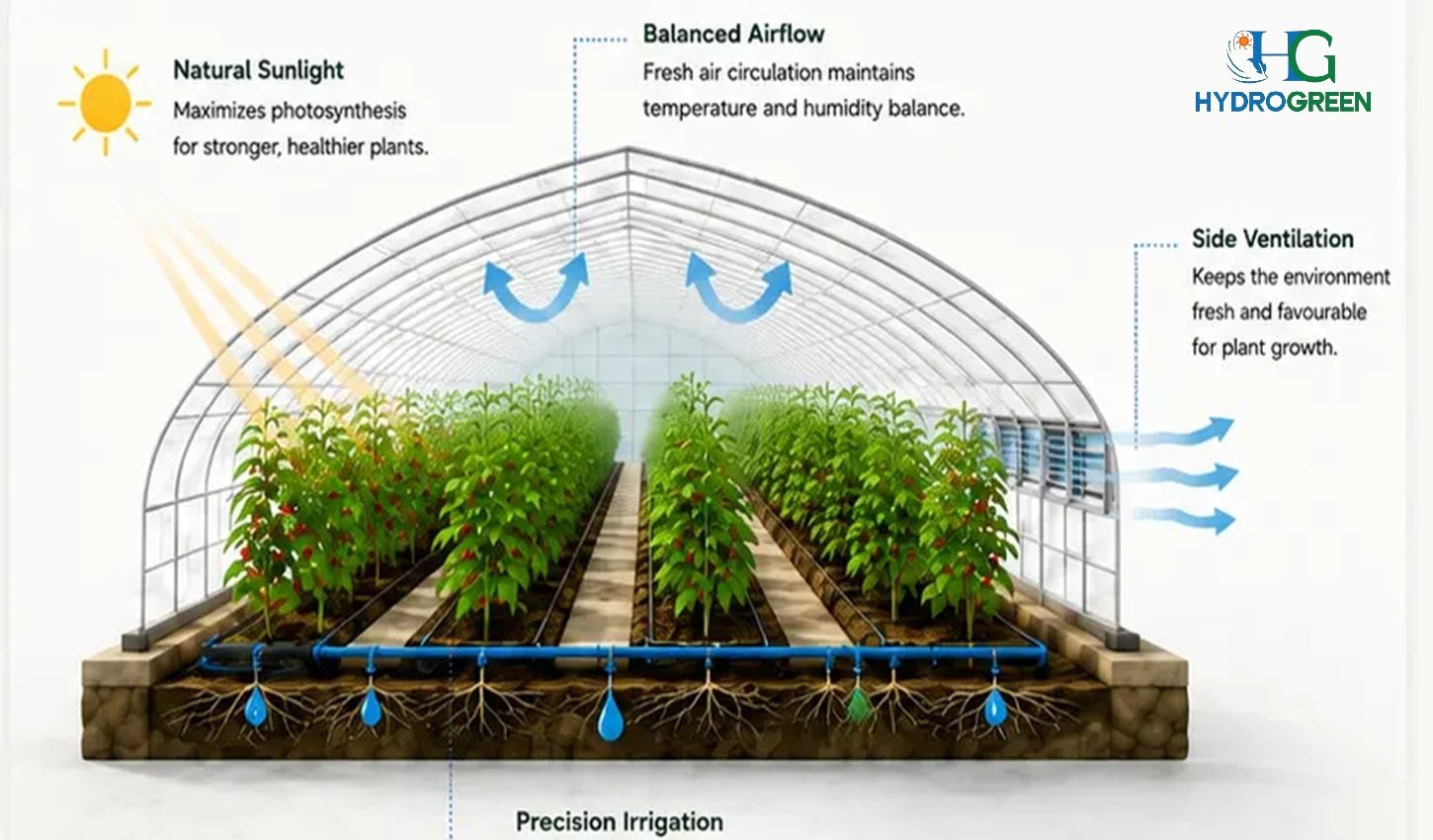
Sunlight is essential for photosynthesis, but excessive radiation can also increase leaf temperature and water demand. The polyhouse covering changes how solar energy reaches the crop. Transparent agricultural plastic allows useful light to enter while the structure alters the exchange of heat and air between the inside and outside environment.
ICAR describes greenhouse covering as a means of allowing solar energy to enter the structure, contributing to temperature increase and providing light required for crop growth. However, more sunlight is not automatically better.
The crop needs appropriate light intensity and duration, and the requirement varies with species, growth stage and season. This is why the choice of covering material, structure orientation, ventilation and shading strategy should be considered together rather than independently.
Proper light availability supports:
At the same time, excessive radiation can increase heat load and plant water demand. A well-designed protected structure therefore aims for a useful light environment, not simply maximum sunlight.
Temperature is one of the most important components of the polyhouse growing environment. During cooler periods, the enclosed structure can help retain some of the heat gained from solar radiation. During hot periods, however, the same solar gain can become a challenge. This is where ventilation and cooling become important.
Naturally ventilated polyhouses use openings, vents and roll-up sidewalls to encourage the movement of air. Warm air can escape while comparatively cooler outside air enters, depending on the prevailing conditions. ICAR research on protected structures highlights the importance of location-specific design and suitable ventilation arrangements for achieving appropriate environmental conditions.
In climate-controlled structures, exhaust fans and evaporative cooling pads can be used to manage high temperature conditions. The principle is straightforward:
Hot air removal + evaporative cooling = reduced heat load inside the structure
ICAR's recent protected-cultivation guidance describes fan-pad systems as a component of higher-control structures used for temperature management. The appropriate system depends on the local climate, crop requirement and project economics.
Relative humidity is another major component of the crop microclimate. Plants continuously lose water through transpiration. The surrounding humidity influences how quickly this water moves from the plant to the atmosphere. A polyhouse can change humidity because it modifies air movement, temperature, evaporation and transpiration. But high humidity is not automatically desirable.
Excessive humidity combined with inadequate ventilation can increase the risk of an environment favourable to certain fungal and bacterial diseases. On the other hand, excessively dry conditions can increase plant water stress. Therefore, humidity management is closely connected with:
This is one reason why simply closing a polyhouse during adverse weather is not sufficient. The internal environment still needs active observation and management.
Ventilation is much more than opening the sides of a polyhouse. It influences:
In a naturally ventilated structure, roof vents and side openings can help move air through the crop zone. The design of these openings matters because air movement inside a structure is not necessarily uniform. A study of cucumber cultivation in a naturally ventilated polyhouse found measurable variations in temperature, relative humidity and light at different locations and times within the structure. This has an important practical implication:
A polyhouse should be managed as a living microclimate, not as a uniform box.
Crop density, plant height, structure design and ventilation position can all influence conditions around the plants.
Weather does not only affect temperature. It also determines how much water is available to the crop. Inside a polyhouse, irrigation can be separated from rainfall and managed according to crop demand. Drip irrigation is commonly used in protected cultivation because water can be delivered directly to the crop root zone. This can help the grower manage:
Research conducted at GB Pant University examined water requirements of tomato, cucumber and capsicum under naturally ventilated polyhouse and open-field conditions, showing why water management under protected cultivation should be considered separately from open-field irrigation. The important principle is not simply “use less water.”
It is: Apply the right amount of water at the right time according to crop demand and growing conditions.
A controlled growing environment becomes more useful when irrigation and nutrition can also be managed precisely. Through fertigation, soluble nutrients can be supplied through the irrigation system. This allows nutrient delivery to be adjusted according to:
In modern protected cultivation, environmental control and resource management increasingly work together rather than as separate activities. This is particularly important because environmental conditions influence plant growth, while crop growth influences water and nutrient demand.
A good polyhouse system therefore connects:
Climate → Water → Nutrients → Crop Growth
rather than treating each factor independently.
The polyhouse structure can also act as a physical barrier against the entry of some insects when appropriate insect-proof netting is incorporated. This does not mean that pest problems disappear. Pests can still enter through doors, openings, planting material or human movement, and pest populations can develop inside the structure if monitoring is poor.
Therefore, protected cultivation should combine:
The objective is to reduce unnecessary exposure and make pest management more manageable—not to assume that a polyhouse is completely pest-proof.
It is easy to focus on the air above the crop and forget the environment below it. But healthy roots require appropriate:
Poor drainage can create waterlogging even when the air environment appears ideal. Similarly, excessive irrigation can create an unsuitable root-zone environment and waste nutrients. This is why polyhouse management must consider both:
Above-ground microclimate + Below-ground root environment
Together, they determine how effectively the plant can use available water and nutrients.
A well-designed polyhouse cannot compensate for poor crop management. Training, pruning, spacing and canopy management can influence:
ICAR-IIVR's work with tomato under polyhouse conditions demonstrates the importance of combining protected structures with crop-specific technical practices such as training, pruning and drip irrigation. This highlights a key principle:
The structure creates the opportunity; crop management converts that opportunity into results.
No. The level of environmental control depends on the type and design of the structure. A naturally ventilated polyhouse primarily relies on passive ventilation and appropriate structural design. A more advanced climate-controlled greenhouse may use:
ICAR's protected-cultivation literature distinguishes naturally ventilated, medium-control and high-tech structures according to their degree of climate-control capability.
Therefore, “controlled environment” does not necessarily mean “fully automated environment.”
The right level of control should be selected according to crop requirements, local climate, investment capacity and expected production system.
One of the most important principles in protected cultivation is that there is no single ideal polyhouse climate for every crop. Tomato, capsicum, cucumber, flowers and nursery plants have different environmental requirements. Even the same crop may require different conditions during:
For example, ICAR's 2025 farmer advisory provides crop-specific temperature and humidity guidance for capsicum rather than treating all protected crops identically. This means polyhouse planning should begin with the crop—not with the structure alone.
A practical project-planning framework is:
Crop → Climate → Structure → Covering → Ventilation → Irrigation → Fertigation → Environmental Management → Economics → Market
If one element is poorly matched, the entire system can become less effective.
A structure can modify the environment, but it does not automatically create perfect conditions.
Insufficient ventilation can allow heat and humidity to build up.
Crop water demand changes with temperature, crop stage and environmental conditions.
Temperature is important, but humidity and air movement also influence crop health.
Excessive plant density can restrict air movement and light penetration.
The structure should be matched to the crop, climate and production objective.
Sensors and automation are useful tools, but they do not replace crop-specific management.
Creating a suitable polyhouse growing environment begins well before the first seedling enters the structure. The structure, covering, ventilation, irrigation, fertigation and crop-management approach need to work as one system.
Hydrogreen Energy Private Limited approaches protected cultivation from this project-planning perspective. Instead of looking at the polyhouse only as a physical structure, the focus is on matching the protected cultivation system with the crop, local conditions and intended production model.
Depending on the project requirement, this can involve planning around:
This integrated approach is important because a successful protected-cultivation project depends not only on installing a structure, but also on managing the environment created inside it. Planning a protected cultivation project? Explore Hydrogreen's solutions or connect with the Hydrogreen team to discuss the environmental requirements of your crop.
A polyhouse modifies the crop's surrounding microclimate by controlling or influencing sunlight, temperature, humidity, ventilation, water availability and, in advanced systems, other environmental parameters.
No. Temperature inside a polyhouse changes with outdoor weather, solar radiation, ventilation, structure design and cooling systems. Monitoring and management are required to maintain suitable conditions.
Ventilation helps remove excess heat and moisture while supporting air movement and gas exchange. Proper ventilation is especially important during warm and humid conditions.
Yes. Irrigation can be scheduled according to crop requirements using systems such as drip irrigation. Water application can be adjusted according to crop stage and environmental conditions.
No. A polyhouse can provide a physical barrier against some external pest pressure, particularly when insect-proof netting is used, but pests and diseases can still occur. Monitoring and proper crop-management practices remain necessary.
No. A naturally ventilated polyhouse provides environmental modification, primarily through structural design and passive ventilation. More advanced structures provide a higher degree of active climate control.
Important parameters include temperature, relative humidity, light conditions, irrigation/root-zone moisture and, where relevant, CO₂ and other crop-specific environmental indicators.
No. Environmental requirements vary between crops and growth stages. The structure and management system should therefore be designed around the crop and local climate.
A polyhouse creates a better growing environment not because it completely separates crops from nature, but because it gives the grower greater influence over the conditions surrounding the crop.
The covering modifies solar radiation. Ventilation influences temperature, humidity and air movement. Irrigation manages water availability. Fertigation supports precise nutrient delivery. Insect-proof barriers can reduce certain external pest pressures, while crop management helps make better use of the environment created inside the structure.
The real value of protected cultivation lies in bringing these elements together.
The most effective polyhouse is therefore not simply the one with the most technology. It is the one in which crop requirements, climate, structure and management are correctly matched.
For farmers and agribusinesses planning protected cultivation, understanding this relationship is the first step toward building a productive and manageable growing system.
~ TANYA TOMAR
(Protected Cultivation Expert)
Vision: Helping growers understand the science behind crop microclimates so that protected cultivation can be planned around the actual needs of plants, rather than simply around the structure.